
Make your own pasta all’uovo – egg pasta – with Mario Matassa’s recipe. It’s the ideal starting point for cooking numerous delicious pasta dishes…
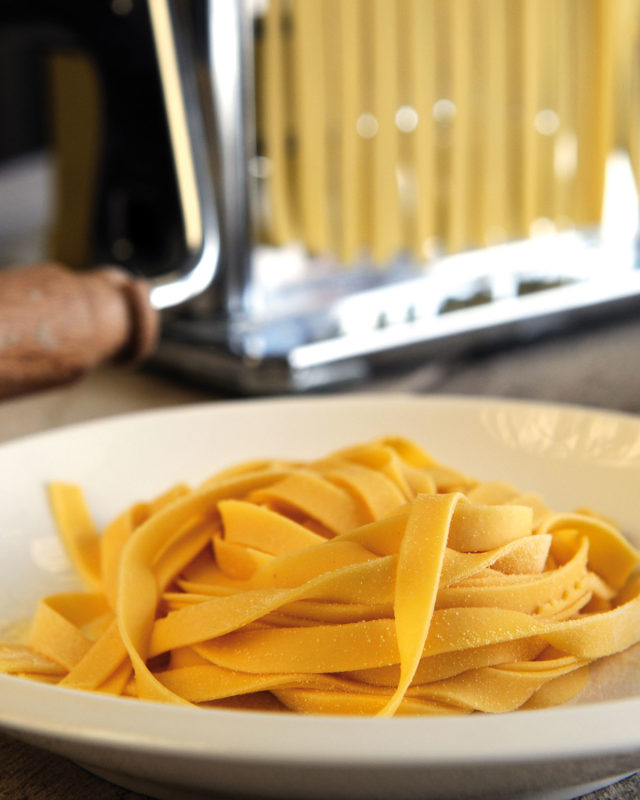
Knowing how to make fresh pasta is a basic survival skill in Italy. There’s no place in an Italian kitchen for anyone who does not know how to make pasta – it’s that fundamental.
Outside of Italy, cooks often shy away from the challenge of making pasta, opting instead for the convenience of so-called fresh pasta from the supermarket. To be honest, it’s not something any self-respecting Emilian cook would consider an acceptable alternative. It’s just not the same. Plus, it’s really not difficult to make your own.
It all comes down to this: four eggs, 400g of flour, four litres of water and a tablespoon of salt. That’s roughly the perfect formula for four hungry people.
Of course, when it comes to pasta, measurements are at best indicative. It’s a question of understanding how the dough should feel and knowing how environmental conditions will affect the outcome. Different eggs will absorb the flour differently, and on any given day environmental conditions will play a role too.
The key is not to get flustered. If the dough feels too crumbly, wet your hands or add a teaspoon of water. If it’s too wet, add flour. If you are an absolute beginner, the easiest thing to do is to add a tablespoon of olive oil. This will make the dough more elastic and easier to work.
When it comes to cooking pasta, there are a few guidelines to observe. Fresh pasta cooks quickly, so it should be added once the water is boiling vigorously, and all in one go. Don’t forget to add salt to the water, a little extra if the sauce you are serving is bland. As for olive oil, save it for the salad. Whoever perpetuated the myth that you should add a few drops of olive oil to the water either to stop the pasta sticking or to make the water boil more vigorously didn’t come from Emilia, and most likely buys their pasta from the supermarket.
A flat pasta, such as tagliatelle, will take a mere 20-25 seconds to cook after the water into which it has been dropped returns to the boil. As it should be served immediately. It is important that you are ready to eat, so have your sauce prepared, your cheese grated, and everyone sitting at the table!
Egg pasta | Pasta all’uovo
➤ SERVES: 4
➤ PREPARATION: 30 minutes, plus resting
Ingredients:
- 400g plain flour
- 4 medium free-range eggs
Instructions:
- Place the flour on a large worksurface and make a well in the middle. Break the eggs into the well, then beat the eggs with a fork. As you do so you will begin to draw a little of the flour into the eggs. This is fine, but be careful not to break the well at this stage or you’ll have a real mess on your hands!
- Once the eggs are beaten you can continue to draw the flour into the beaten eggs. As you do so the mixture will begin to thicken to a consistency that will eventually allow you to use your hands to knead everything together.
- Knead the flour and egg mixture until a smooth consistency is formed. This will take up to about five minutes to do properly.
- Allow the kneaded dough to rest under a tea towel for 20-30 minutes. Don’t skip this part as the pasta really does need plenty of time to rest. It makes it much easier to work with later.
- After you have rested the pasta, if you are using a pasta machine (which is by far the easiest way to do it and in no way counts as cheating) cut off a peach-sized ball of dough and begin feeding it through the largest setting of the pasta machine. (If you are not using a pasta machine, skip now straight to Step 9.)
- Fold the pasta sheet onto itself and feed it through again. Keep repeating this step until the dough feels smooth and silky. Don’t despair if the dough seems crumbly and dry, just keep feeding it through the machine and it will come together. If the dough keeps sticking, dust it with flour before each rolling.
- Once you are happy that the pasta is silky and smooth, lower the width setting and feed the pasta sheet through again. Keep lowering the width setting and feeding the pasta through until you reach the thinnest setting.
- If you have a special attachment on your pasta machine that allows you to make tagliatelle or spaghetti alla chitarra, feed your sheet of dough through this to cut the pasta. If you don’t, generously dust the pasta sheet with flour and fold it up on itself, then, using a sharp knife, cut strips 1-2cm wide for tagliatelle, 2-3cm wide for pappardelle, or 2-5mm wide for spaghetti. For lasagne sheets, cut the sheets into 10cm lengths.
- If you are rolling by hand, make sure you have a large enough work surface – you will need a surface at least 1 metre wide and 2 metres long for this much dough, plus a really long rolling pin – double the standard size. Start rolling and continue until the dough is just 1mm thick. This requires patience and elbow grease. It will also make you want to buy a pasta machine!
Browse more Italian pasta recipes
Words and recipe by Mario Matassa