
Jenny Oldaker traces the 15th-century origins of Sulmona’s world-famous confetti, discovering how these sugar-coated treasures became the vibrant heart of Italian celebrations and Abruzzese culture.
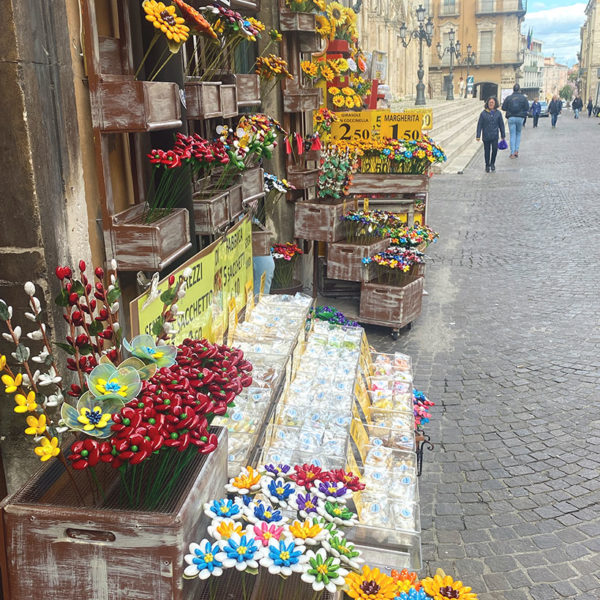
Taking a stroll down Sulmona’s Corso Ovidio is a colourful affair. Wander any length of this elegant thoroughfare and you’ll soon be greeted by scores of shops brimming with pops of vibrant colour that stand boldly against the muted hues of the town’s medieval architecture.
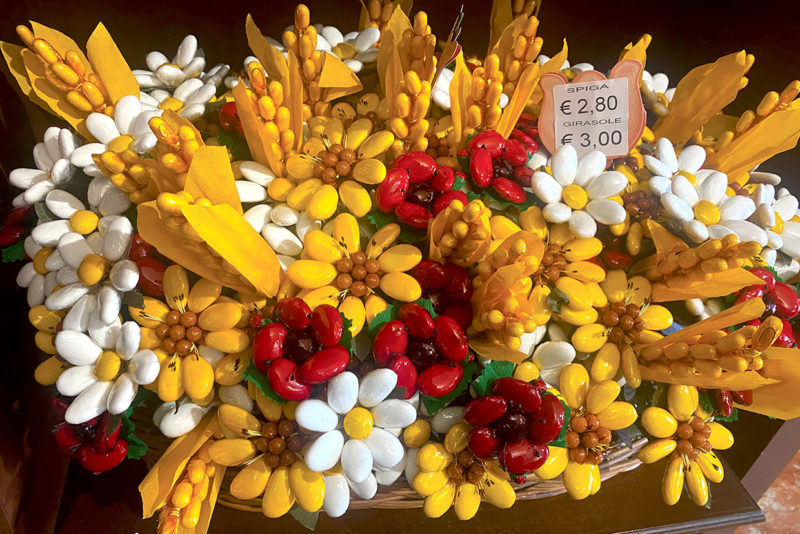
Sulmona’s famous confectionery, confetti – better known in English as sugared almonds – are responsible for this cheerful spectacle. These sweets are showcased in a multitude of artistic forms, wrought into floral displays, ears of corn, ladybirds, cartoon characters, or simply bagged in crisp, elegant packaging.
The pleasing spectacle is hard to resist (as a recent visitor, I can attest to their powerful lure!) and it’s not a recent phenomenon either – the town’s vendors have been peddling their sweets here for centuries. Back in 1843, the English painter and poet Edward Lear remarked on them during his travels to Sulmona, writing in his Illustrated Excursions in Italy:
“We admired its well-paved streets and numerous shops, (half of which seemed confectioners’, for the confectionery of Solmona [sic] is famous all over Italy).”
Sulmona and its famous confetti
These sweets were not even recent innovations during Lear’s time. While confetti as we know them today can be dated to the 15th century, early versions go back even further. These distant relatives of confetti were reputedly developed by the Romans, who celebrated births and marriages with similar sweets, made with honey. The sugar-coated nuts were also described by Boccaccio in his 14th-century Decameron.
It was the arrival of sugar cane in Europe in the late 15th century that marked the dawning of the confetti for which Sulmona is famed today. This newly introduced ingredient helped to create the sweets’ all-important crispness. Production originally centred around the Santa Chiara monastery, where the nuns of the Poor Clares order were the first to give the confetti its decorative flourishes, creating flowers, wreaths and rosaries, and wrapping the sweets in silk to give to local brides.
Indeed, confetti have long been linked to landmark celebrations such as weddings, and in these early days, with sugar still an expensive luxury, they were almost exclusively the preserve of the wealthy. As time went on sugar became more widely available, and by the second half of the 18th century there was a surge in the production of confetti in Sulmona. Soon, there were twelve factories operating in the town, all striving to create ever more spectacular and varied iterations of the sweets.
The Pelino confetti factory and museum
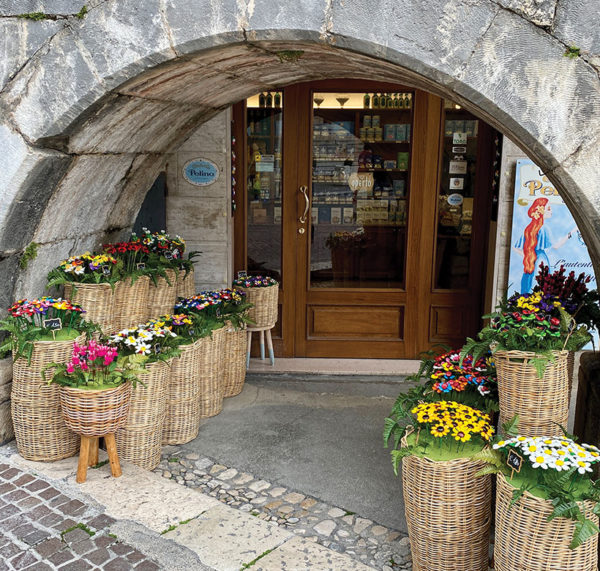
Confetti Pelino (today perhaps the most famous name in Sulmonese confetti ) was among the factories that sprung up around this time. It opened in 1783 and now exports its goods around the world.
Although the term confetti now covers confectionery in a range of flavours and centres – from dried fruit to hazelnuts, pistachios and more – the ‘true’ sugared almond is composed of a whole shelled, peeled almond, which is then coated with deposits of sugar to create layers. Crucially, this is done without using starch, which helps it achieve its unique lightness and delicate flavour.
Pelino’s factory is just a short walk out of town and is a fascinating place to explore the sweets. There’s a viewing area over a section of the factory where you can watch the artisans at work, as well as areas where you can watch the sweets being packaged into their finished forms.
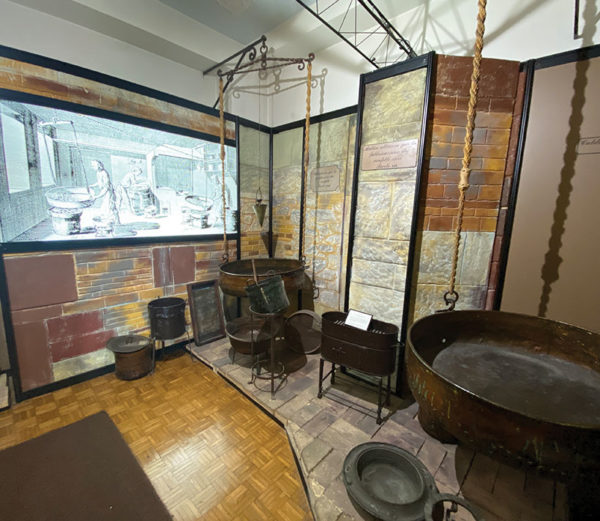
Upstairs there’s a museum that delves into the history and evolution of the sweets. One of the highlights is the collection of antique machinery and equipment for making confetti, dating right back to 1490. This collection includes 18th-century copper utensils for processing the nuts and a 20th-century ‘silvering machine’ for the process of plating the central almond in a fine layer of silver leaf.
The whole experience offers a tangible sense of the way these processes have been finessed over the centuries, as well as the time and care that goes into the production of these exquisite sweets. Tours are available too, and the top floor features a video showing historical background on the factory and its produce.
It’s almost impossible to leave Confetti Pelino without taking home a souvenir from its store, which is a true feast for the eyes. It’s a traditional-style sweet shop stacked to the rafters with confetti in all colours and flavours, and awash with displays of confetti in a host of appealing designs, from intricate floral bouquets to bunches of grapes and more. All beautiful, authentic, delicious souvenirs of the area.
Luck, love and confetti traditions
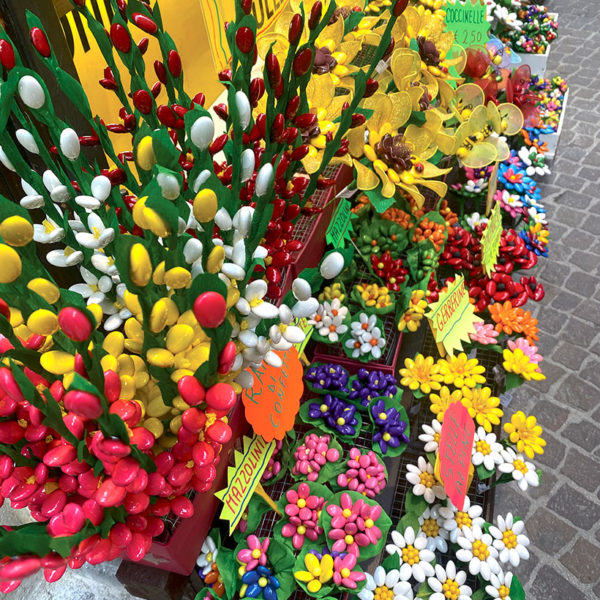
Besides their popularity with visitors to Sulmona, confetti have retained their association with important life events for Italians in general and, many centuries after their invention, they are still a fixture at weddings in Italy. Their reach even extends to elite unions beyond Italian shores – royal weddings in the UK, from Charles and Diana to William and Kate, have featured the sweets.
At such events white confetti are traditional, while other colours are used to symbolise other life events:
- Pink or blue: To commemorate baptisms.
- Green: For engagements.
- Red: For graduations.
The number is just as important as the colour. Odd numbers are considered auspicious, which is why you will always find an odd number of confetti given in bombonniere (the bags made up for special occasions).
These luxurious sweets make a wallet-friendly, beautiful and authentic souvenir of a stay in the area, and after you’ve discovered, tasted and shopped for these jewel-bright treats that adorn Sulmona’s shops, make sure you give yourself plenty of time to explore the rest of this lively, historic town, which is home to a host of other delectable attractions.
Discover a springtime tradition in Sulmona: See the Easter procession in Abruzzo
Written by Jenny Oldaker(@jen_writes_things) for Italia! 218 (Dec/Jan 2026)