
Looking for things to do in Taranto? Val Nicastro introduces us to the hidden delights of Puglia’s second city…
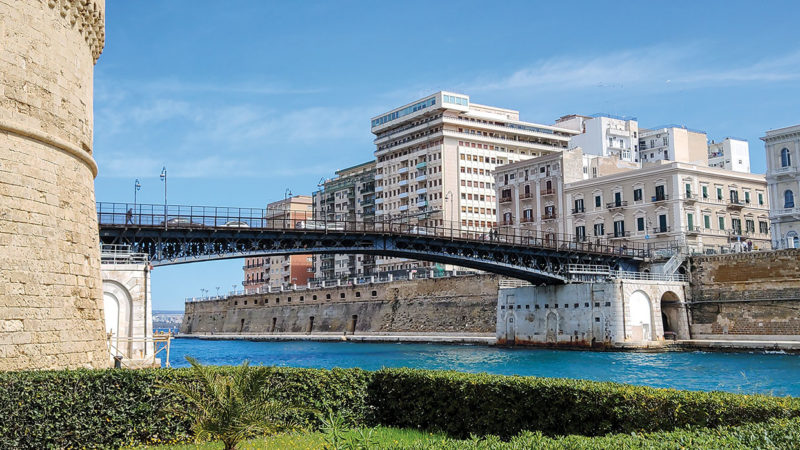
Despite being Puglia’s second-largest city, Taranto often slips under the radar of travellers, overshadowed by its industrial reputation. Yet it is a city rich in beauty and history.
Dubbed the ‘City of the Two Seas’, it is situated between the Ionian Sea (called Mar Grande – the Great Sea) and a lagoon-like basin called Mar Piccolo (the Little Sea).
It was founded in 706 BC by the Spartans, who made it their only colony outside Greece, giving the city a fascinating past that unfolds in every cobblestone and ancient ruin you stumble upon. Today, a swing bridge connects Taranto’s storied heritage with the energy of its modern district, blending ancient tales with contemporary life.
But its true magic lies within Taranto’s people. The locals are warm and proud, always ready to share their city’s hidden gems – whether it’s the best place to eat, the most picturesque alleys, or the spots rich with stories.
They welcomed me like family, and now it’s my turn to share this with you. So, go ahead. Let Taranto work its magic on you. Embrace its past, immerse yourself in its present, and get lost in its irresistible charm. Here are 10 places to start…
Top 10 things to do in Taranto:
1. Explore 3,000 years of history in Taranto
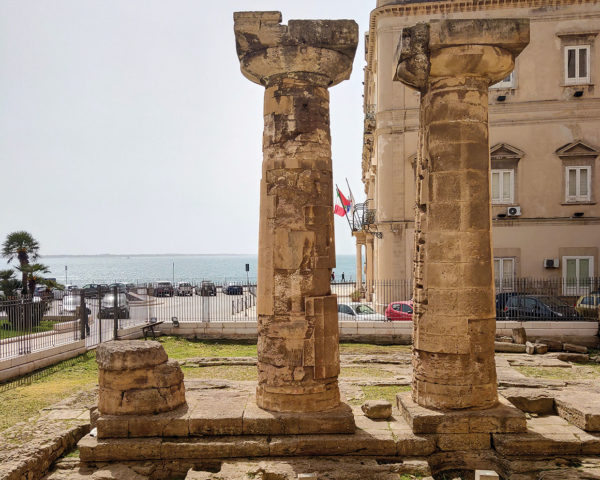
The ancient heart of Taranto sits on a little island that exudes 3,000 years of history, making you feel as if you’ve stepped into a time capsule. This is where the Greek Acropolis once stood, its legacy marked by the two Doric columns at the beginning of Via Duomo. These are the proud remnants of the Temple of Poseidon, one of Magna Graecia’s oldest structures.
This part of Taranto is more than just a historical site – it’s a rugged beauty, an enchanting labyrinth waiting to be explored. No wonder filmmakers love it here. I even stumbled upon a set for the Commissario Ricciardi series!
So, forget the map and let your curiosity be your guide. Wander through narrow alleys (try finding Vicolo degli Innamorati, just half a metre wide, for a touch of romance), climb weathered steps to discover palaces that whisper tales of grandeur amidst their crumbling yet hauntingly beautiful façades.
Admire lively murals and be prepared to uncover hidden wonders like Mr Giudetti’s workshop on Via Duomo, where a 12th-century deconsecrated church turned art space promises a unique cultural journey.
2. Discover Castello Aragonese – Taranto’s symbolic castle
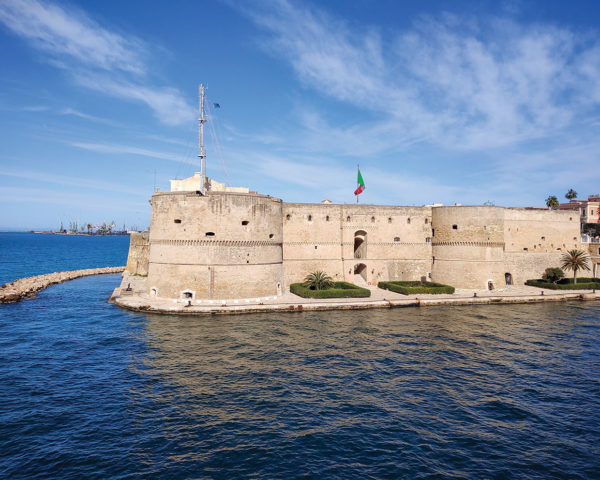
Like many port towns, Taranto boasts a grand fortification that has stood sentinel over the centuries, and today Castello Aragonese is a symbol of the city. The ancient structure originally served as a defensive outpost over 2,000 years ago, but it didn’t start to look like the castle as we know it today until the late 1400s.
Upgraded for King Ferdinand II of Aragon, the fortress’s modern design was devised by the engineer Francesco di Giorgio Martini, and is considered a masterpiece of Renaissance military architecture. Francesco di Giorgio went beyond simply building a military stronghold. Instead, he used his skills in maths and geometry to design a fortification that could embody both strength and beauty.
Over the centuries, the castle’s role has evolved from guarding the city to serving as a prison, and eventually it became the headquarters of the Italian Navy.
Within its walls, you’ll find layers of Taranto’s history and countless fascinating tales. A particularly intriguing one is that of General Thomas Alexandre Dumas, the first mulatto general in history, who was also father to Alexandre Dumas, author of The Count of Monte Cristo.
While returning from the Egyptian campaign, General Dumas was imprisoned in Castello Aragonese. The two-year confinement that followed left a profound impact on him and inspired his son to immortalise the experience in his famous novel.
3. Experience the Rites of Holy Week
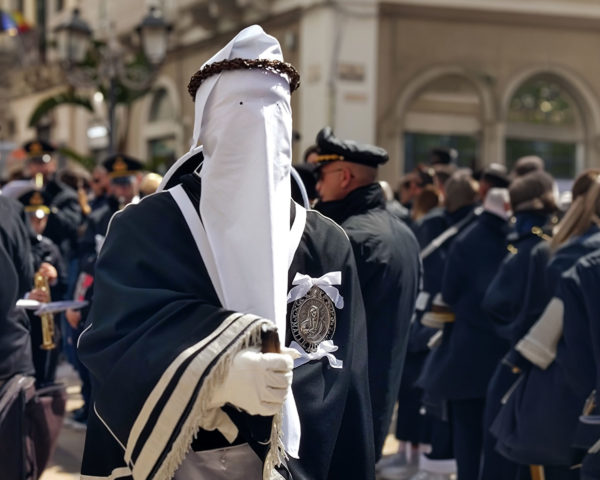
When Easter Approaches, Taranto transforms. Daily life slows to a standstill, and the entire community immerses itself in solemn processions that go on until the early morning hours.
The streets resonate with eerie yet captivating sounds of funeral marches, mixed with the rhythmic clatter of the troccola – a wooden instrument replacing the silent church bells. Hooded figures, barefoot and cloaked in mystery, glide through the city with a slow, hypnotic pace known as nazzecata. The air is thick with a blend of prayer, penance, and eager anticipation. It is an experience that will leave you utterly spellbound.
Palm Sunday adds a quirky twist to Taranto’s Holy Week. This is when local brotherhoods engage in a lively auction to secure the privilege of carrying sacred symbols and statues during the processions. Bids soar sky-high. Rumour was that 2024’s offers reached over €100,000 to shoulder the statue of Our Lady of Sorrows!
4. Taste the ‘gold of Taranto’ – its mussels
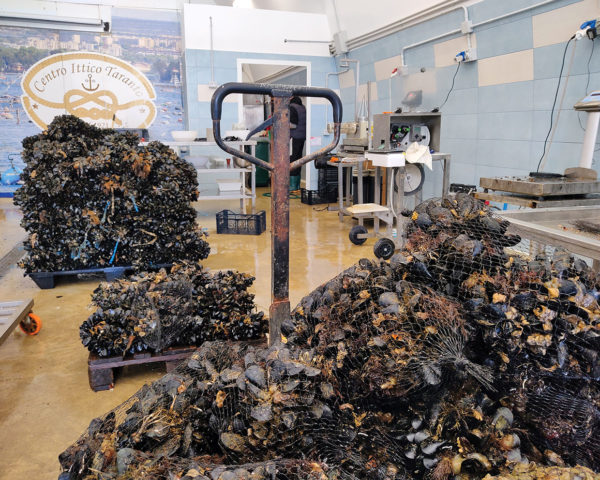
If you’re a seafood lover, the Taranto mussel (or la cozza tarantina) will become your new obsession. These plump, sweet mussels are the city’s pride and joy, and for good reason.
What sets them apart is their special habitat in the Mar Piccolo, where more than 30 freshwater springs from the Alta Murgia (called citri) blend with the salty seawater. This mix creates a totally unique environment that gives these mussels their distinct flavour.
Mussel farming in Taranto dates back to ancient times, all the way to the Greeks and Romans. It’s still thriving today, and every mussel is still hand-harvested using traditional methods. In 2022, these tasty molluscs even earned the prestigious Slow Food Presidium status, recognising their cultural and culinary importance.
So, when you’re in Taranto, sampling le cozze is a must. Whether gratinéed, fried, tossed in a fresh tomato sauce with tubettini pasta, or served straight from the sea, as the local saying goes, Spacc e mang (‘crack and eat’), Taranto mussels promise a fabulous flavour experience.
5. Watch dolphins playing in the city’s sea

Ever dreamed of seeing dolphins up close? In Taranto, you can!
These beautiful creatures have been calling Taranto’s blue waters home for more than 4,000 years. With depths reaching over 1,000 metres, a mild climate and plenty of oily fish, they are an absolute paradise for dolphins.
Taranto and its dolphins share a magical bond, woven into local myths and legends. Taras, the city’s mythical founder, arrived on a dolphin’s back, and Phalanthus was saved by a dolphin during the shipwreck.
Today, this special connection lives on through the Jonian Dolphin Conservation, which studies and protects these animals. They’ve even established Europe’s first Dolphin Sanctuary for rescued dolphins.
You can hop on a boat with their biologists to spot dolphins in their natural habitat, and their passionate team will guide you through Taranto’s maritime heritage at Ketos, their exhibition space located in a beautiful palace in the old town. The visit includes a peek into their lab and an augmented reality experience that’s seriously cool!
6. Go on beachside escapades
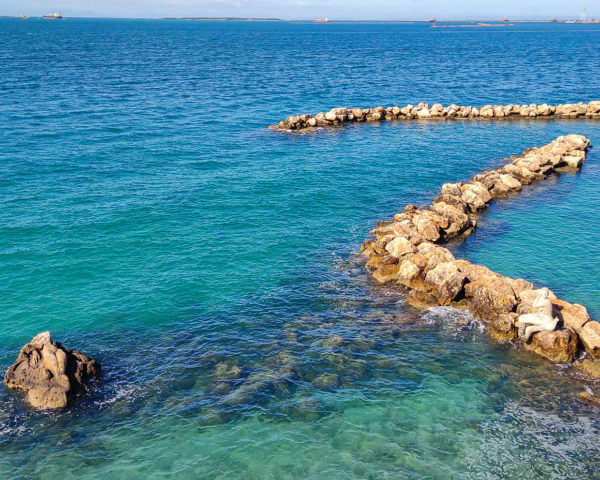
As is true in much of coastal Puglia, another can’t-miss experience in Taranto is hitting the beach! Taranto’s coastline boasts some of the clearest, most stunning waters in the Ionian Sea, earning it the nickname Costa Cristallo (Crystal Coast).
Imagine sinking into soft, powdery sand, with shallow waters lapping the shore, creating an idyllic pool-like playground. Plus, the scenic coastal road, punctuated by ancient defence towers, offers enchanting sunsets and views that stretch endlessly towards the horizon.
Some of the best beaches can be found in Marina di Pulsano and Marina di Lizzano, celebrated for their pristine beauty. For nature lovers, the dunes of Campomarino present a beautiful protected landscape, while thrill-seekers should explore San Pietro in Bevagna, where snorkelling unveils a hidden underwater treasure.
Here, resting peacefully about six metres deep, lie 23 Roman marble sarcophagi lost to the sea during a shipwreck in the 3rd century AD. Originally intended for the burial of esteemed figures, they are known as the King’s Sarcophagi.
7. Explore ancient subterranean wonders
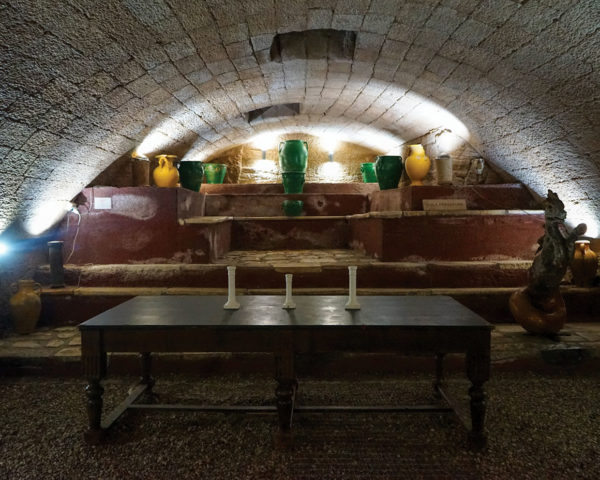
Corso Vittorio Emanuele II reveals yet another gem: the Bellacicco Hypogeum. Carved by the Spartans thousands of years ago to extract building materials, this underground marvel has served as a cellar, warehouse, and more over the centuries. And while Taranto boasts many such hypogea beneath its palaces, this one stands out for its incredible state of preservation.
Meticulously restored by Dr Bellacicco, the hypogeum plunges 16 metres below street level and houses the world’s only Spartan Museum. As you explore its depths, you literally walk through layers of Taranto’s past – from its founding in 706 BC up to the 17th century, when grand palaces rose above it. Look closely, and you’ll even spot the chisel marks left by the Spartans!
Above the hypogeum, the Marquise de Beaumont Bonelli’s 17th-century home is a living historical document offering a peek into the life of Tarentine nobility. Expect to find original handmade Vietri majolica tiles, coffered ceilings, and beautiful frescoes illustrating daily activities from that time.
8. See stunning ceramic chronicles
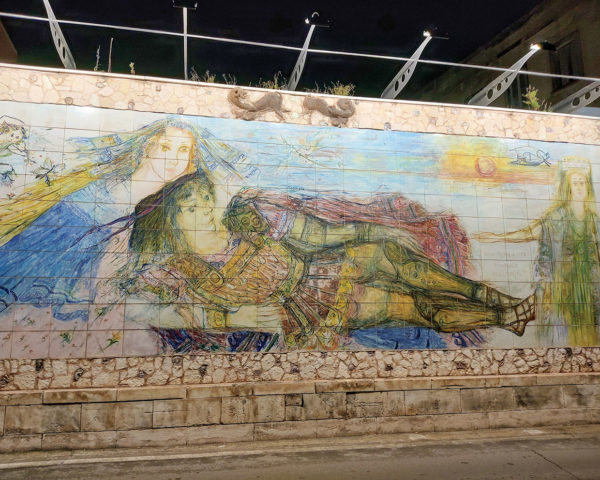
As you stroll along Corso Vittorio Emanuele II, keep an eye out for the stunning mural adorning the wall of the local school gym. Covering an impressive 140 square metres, this is the largest ceramic mural in Europe. This masterpiece, crafted by the skilled hands of Tarentine artist Silvana Galeone, narrates the fascinating story of Taranto’s founding.
At its heart is Phalanthus, leader of the Parthenians, a group of Spartans born from illegitimate unions during the Messenian wars. Following a failed rebellion, they left, convinced by the Oracle of Delphi’s prophecy that they would conquer the Iapygians in Saturo. But the prophecy came with a peculiar condition: victory would come only “when it rains from a clear sky”.
Upon reaching the shores of Satyrion after a shipwreck, victory seemed out of reach. Yet, a moment of despair revealed the true meaning of the prophecy. Phalanthus’ wife, Ethra – whose name means ‘clear sky’ – took him in her arms to comfort him, and her tears fell like rain, fulfilling the oracle’s enigmatic words. Inspired by this revelation, Phalanthus triumphed over the Iapygians and founded Taras, later known as Taranto, named after Poseidon’s son, who first settled Saturo.
9. Visit the oldest cathedral in Puglia
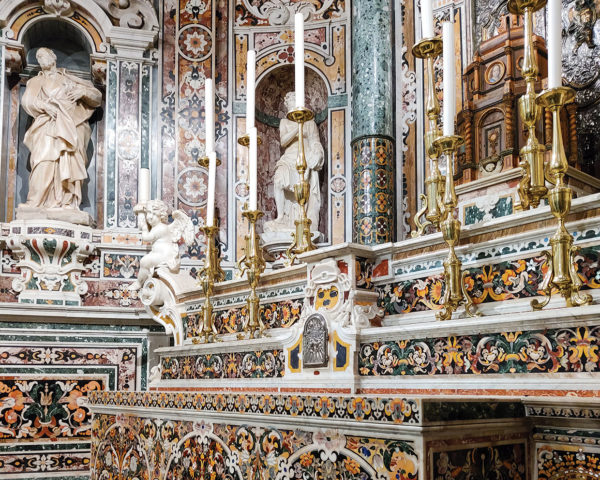
In Taranto’s Old Town, the Cathedral of San Cataldo stands as a testament to faith and artistic mastery. Dedicated to the Irish bishop who became Taranto’s beloved patron saint, this structure is Puglia’s oldest cathedral. While its exterior may appear modest, inside, three naves, adorned with a diverse array of columns, lead the eye upwards to a spectacular wooden and gold coffered ceiling. Beneath your feet, fragments of an ancient mosaic floor whisper stories of centuries past.
The true highlight, however, awaits at the far end. The breathtaking cappellone (literally, ‘big chapel’) of San Cataldo. This elliptical chapel, home to the saint’s relics, is a masterpiece of Neapolitan craftsmanship, showcasing an explosion of precious marbles and hues that defy description. Among its treasures stand eight magnificent statues, including a tender depiction of Saint Joseph with the baby Jesus, sculpted by the legendary Giuseppe Sanmartino, the maestro behind the Veiled Christ in the Sansevero Chapel of Naples.
And here’s an interesting tidbit: Taranto boasts not one but two cathedrals! The second, inaugurated in 1970, is a triumph of contemporary architecture envisioned by the great Giò Ponti.
10. Uncover a treasure trove of local history
Housed inside an 18th-Century convent, Taranto’s National Archaeological Museum (MArTA) is one of Italy’s most important museums, offering a captivating journey through the heart of Mediterranean history. Its extensive collection spans from prehistory to the Roman and medieval periods, with a particular focus on the illustrious Greek period.
Even those less inclined toward history will find themselves mesmerised by this museum’s treasures. Among them, you’ll find exquisite red-figure kraters depicting mythological scenes, intricate gold jewellery dating back to the 3rd century BC, compelling Roman mosaics, and unique artefacts, like a nearly life-sized terracotta ensemble portraying the Thracian singer Orpheus subduing the evil sirens with his music.
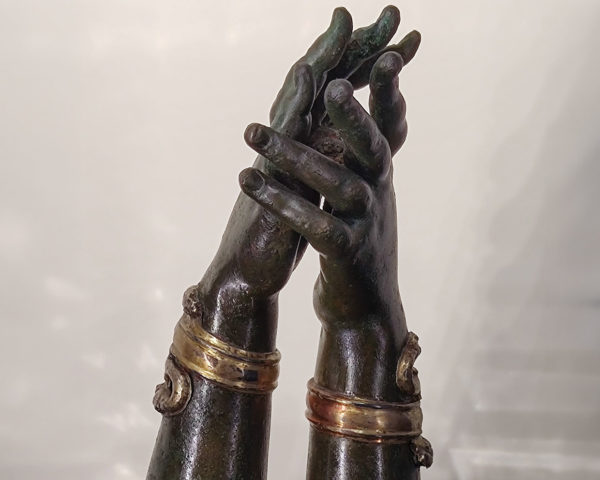
Other notable highlights include a cleverly designed bronze and gold nutcracker shaped like female forearms adorned with gold bracelets (still fully functional, it would surely be a hit at any modern dinner party!), and the tomb of a local athlete. He was a champion of the Panathenaic games in Athens 2,500 years ago, as indicated by four large amphorae guarding his grave, the ancient equivalent of today’s Olympic gold medals.
For more travel inspiration, see our slow-travel guide on things to do in Puglia
Written by Val Nicastro (@my.italiandiaries) for Italia! #213 (Feb/Mar 2025)