
Penny Wainwright steps back into Sardinia’s rich and fascinating past as she heads to the wilds of western Sardinia…
With its beautiful sandy coves and turquoise sea, Sardinia is already well known as a beach destination. And yet, there is so much more to discover, not least around Oristano and the Sinis peninsula.
Here, in western Sardinia, fascinating towns and villages are filled with people who are passionate about keeping alive their history and traditions. To get a glimpse of this ‘wild world’, let Penny Wainwright take you on a tour of 10 must-visit locations in western Sardinia:
1. Fordongianus
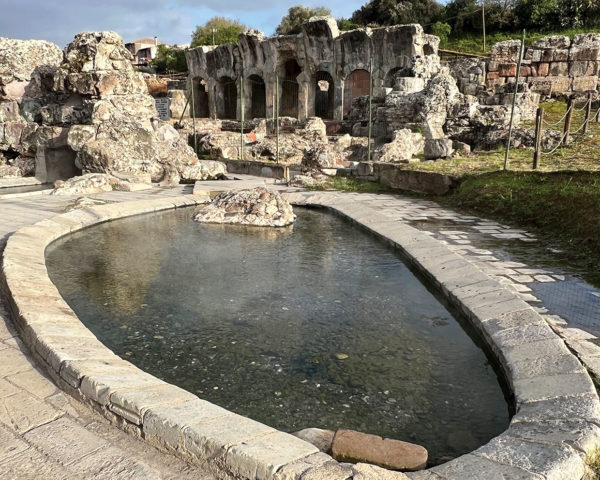
Travelling towards Paulilatino, I followed a sign for Roman thermal baths through Fordongianus village to find cars and camper vans parked close to the river. Many people were basking in the steaming River Tirso in water that remains at around 50 degrees centigrade all year.
Opposite the natural (and free) thermal water is Forum Traiani; the remains of a Forum and Roman thermal baths that open daily to the public for a small charge.
2. Santa Cristina
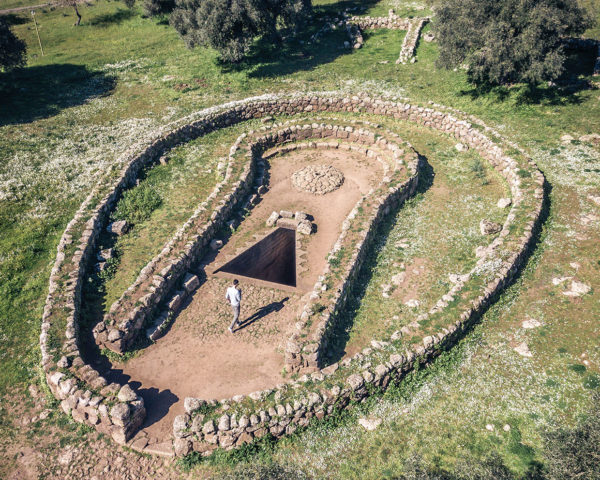
Magic seemed to be present at the 3,000-year-old sacred well of Santa Cristina, just minutes away from Paulilatino. From above, the well resembles a keyhole, but Sardinians believe it is the stylised shape of a woman representing Mother Earth, who holds the secret of life inside her in the well water.
The well is aligned north to south, thanks to ancient astronomers’ knowledge of the stars, the sun, and the moon. At midday on the spring and autumn equinox, people gather to watch as the sun illuminates the large basalt steps, which narrow as they descend to the well.
If a man stands on the top step, his shadow looks like a giant until he descends to the water. At the bottom, his shadow inverts, and he appears to go headfirst into the water.
The ritual is suggestive of man returning to Mother Earth in order to be reborn. The Pozzo Sacro one of the most fascinating places I have ever visited.
3. Paulilatino
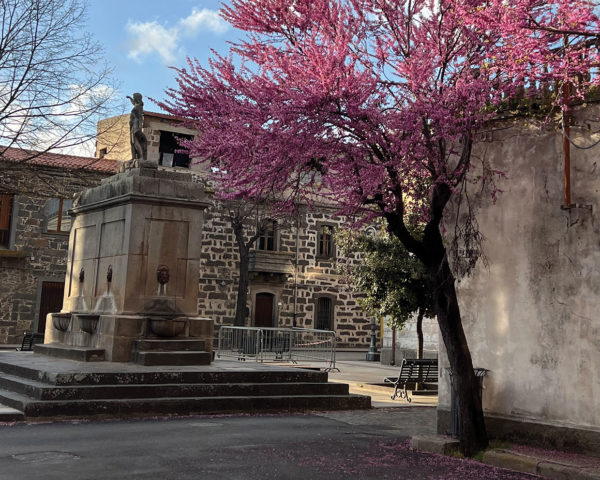
The small town of Paulilatino is a mixture of light and dark, with lowering basalt houses mixed with painted façades and wrought-iron balconies. In the centre is Piazza Su Pangulieri, which has a bar and Bisos, my hotel in Paulilatino.
The current hotel owner is Francesco Urgu. His great-grandfather, Giomaria Urgu, along with his brother-in-law, Angelo, were wealthy merchants in Bosa. They built a home for the Urgu family in Paulilatino with an emporio, or general store, downstairs.
Once run by Angelo, the emporio now serves as the communal breakfast room. Meanwhile, my first-floor room was once occupied by Angelo and the shop safe, which was set in the wall.
Palazzo Atzori, a museum of farming, sits along Via Nazionale. On my visit, however, it was closed for the addition of an archaeological room.
The town has four churches and is surrounded by beautiful open countryside. With Nuragic, Punic and Roman sites nearby, Paulilatino is ideally located for visiting the area.
4. Nuraghe Losa
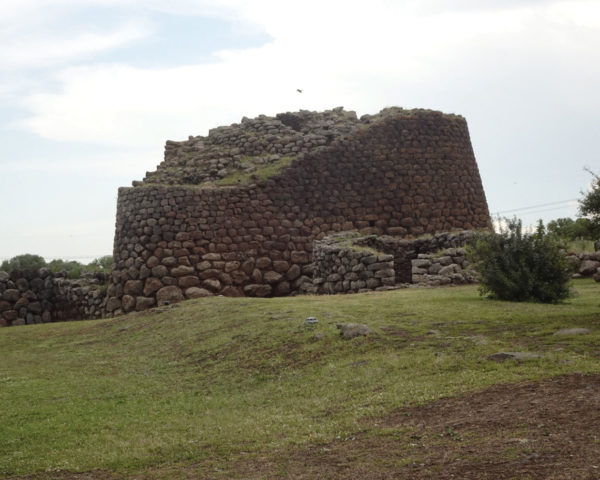
Close to Paulilatino, near Abbasanta, is Nuraghe Losa. A nuraghe is a stone-built tower with a domed roof. There are more than 7,000 nuraghi built from 1600 to 1200 BC in Sardinia, but little is known about them.
Nuraghe Losa is a complex nuraghe with towers set in a triangular layout. The main tower once had three levels. I explored inside and climbed the spiral ramp to the upper room. From the flattened top, I saw the remains of village dwellings stretching far across the countryside.
5. Santu Lussurgiu
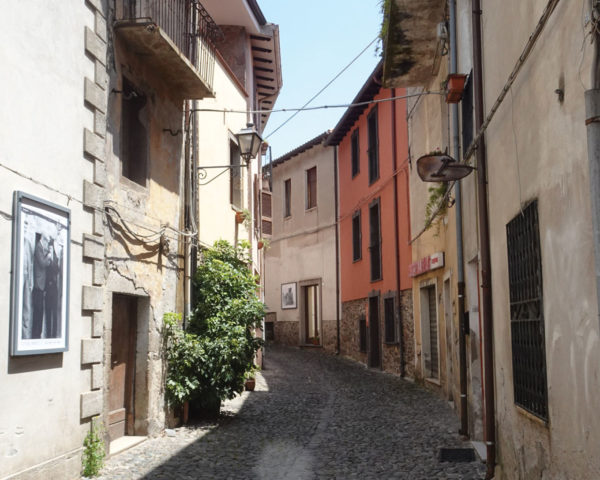
The medieval village of Santu Lussurgiu (San Lussorio in Italian) is built on the extinct volcanic massif of Montiferru (Iron Mountain). Every August, a thrilling and extremely challenging horse race takes place on a course that runs from the Church of San Lussorio all around the narrow, steep, cobbled streets of the village.
I visited Sas Benas, an albergo diffuso that has a restaurant serving Sardinian dishes using locally sourced ingredients. There I ate bue rosso, a local breed of red cattle, and tasted their delicious homemade mirto, a strong liqueur made from myrtle berries.
6. Tinnura & Flussio
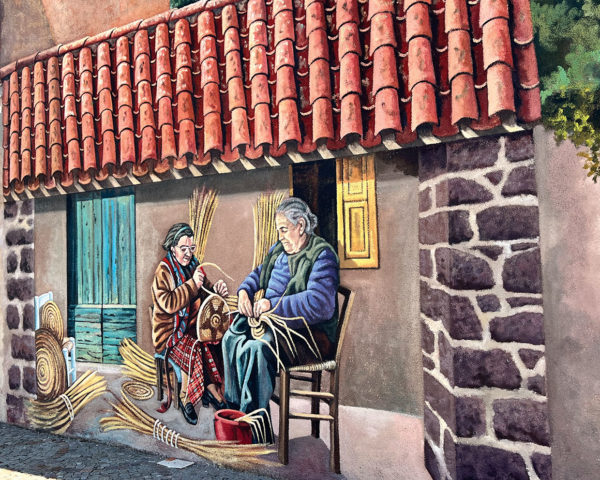
Between Bosa and Paulilatino are the two small villages of Tinnura and Flussio. Tinnura is an open-air – a cielo aperto – museum of murals which celebrates local life and agriculture.
The murals were created by local artist Pina Monne, who lives in the village, and represent local people and their working lives. They show traditional activities and crafts such as farming, harvesting, winemaking and cheesemaking.
In Flussio, families continue the traditional craft of basket weaving. Baskets are woven from asphodel leaves, which are harvested, washed and left to dry in the sun. There is a mural depicting women weaving asphodel baskets, and different-sized baskets are displayed and sold from outside people’s homes. A celebration of the asphodel harvest takes place every April.
7. Bosa
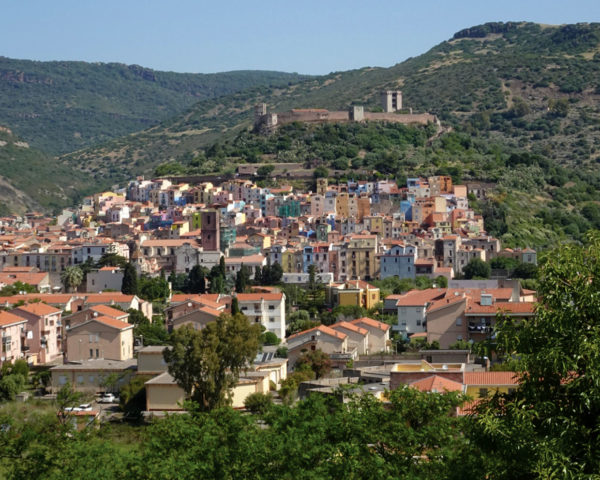
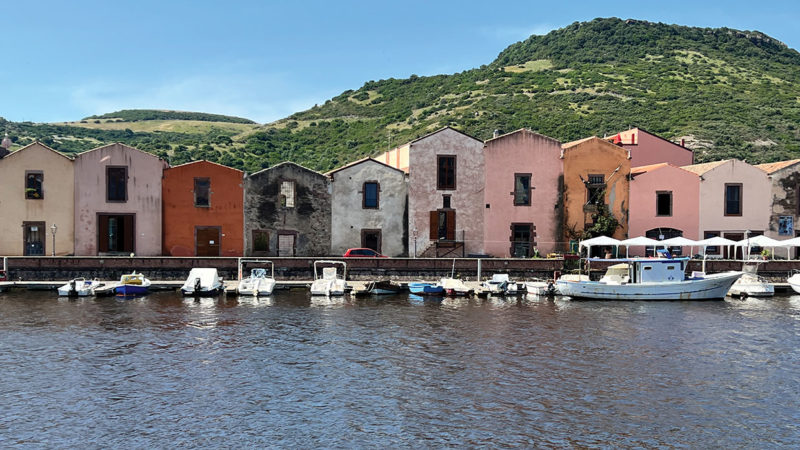
Bosa, where Giomaria Urgu once conducted his trade, is about thirty miles from Paulilatino. From a distance, the town looks like a painting, with its tall, pastel-coloured houses rising in rows to the top of Serravalle Hill and the 12th-century Castello Malaspina. The River Temo runs through Bosa to the sea and brings prosperity to the town.
In the 1700s, Bosa’s wealth came from fishing, silver, gold and coral jewellery, and the leather industry. Tanneries stretched along the river in Sas Conzas. The tannery processes are preserved and explained in the Museo delle Conce. Ponte Vecchio connected the tanneries to the homes of the wealthy industrialists, which were built in Bosa’s main streets and squares opposite.
Corso Vittorio Emanuele II is the main shopping street, with many shops still selling Bosa’s gold filigree and coral jewellery. The historical district of Sa Costa developed on the hill beneath the castle, where parallel rows of streets and tall houses are connected by cobblestone alleyways and steps or stairs, with small squares providing families a place to socialise. I watched Maria create the delicate filet di Bosa, which she sells to visitors outside her home in Sa Costa.
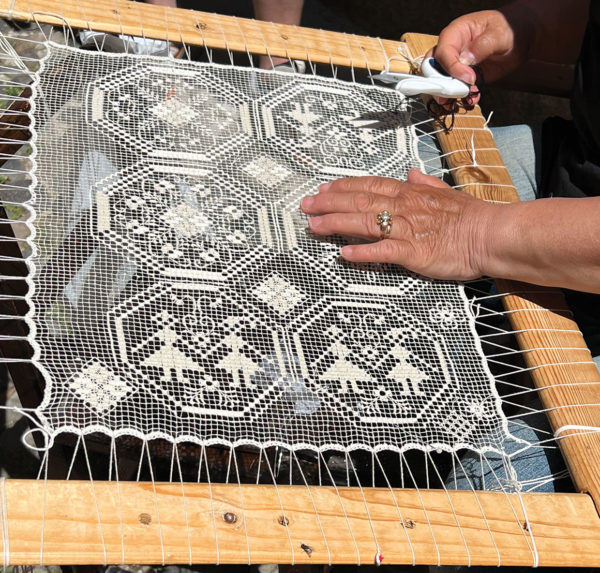
Although small fishing boats continue to leave from Ponte Vecchio and go into the estuary to fish, Bosa Marina today is the main fishing area. The coastline is a Marine Protected Area, but under strict regulations, a small proportion of coral is collected every year by certified divers.
Restaurants specialise in local fish and shellfish caught off the coast. At restaurant Al Galeone in Bosa Marina, I tasted many fish dishes such as seafood salad, fish pasta, grilled sea bass and octopus.
The restaurant is shaped like a ship on the outside, has outdoor seating for warm weather and is very close to the beach, with deck chairs facing the sea. At one end of the beach, the Torre dell’Isola Rossa overlooks the mouth of the river.
Wine production began here at least 1,500 years ago. At the Cantina Columbu, I learnt about their wine production and the unique qualities of the grapes, tasting Alvaréga and Columbu Riserva. These delicious wines are sweet and golden in colour, with the Columbu being reserved for special occasions.
8. S’Archittu
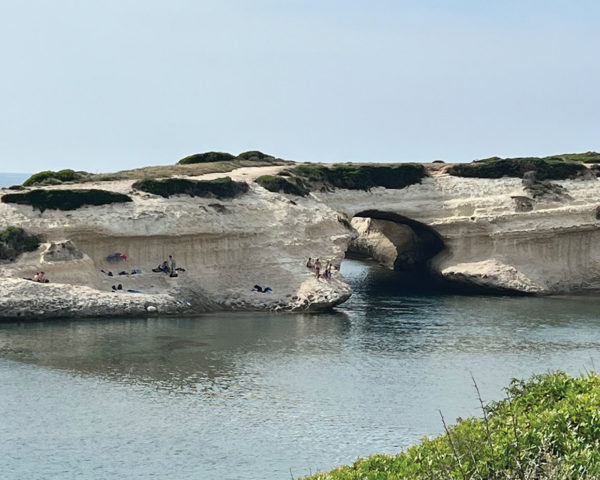
S’Archittu is on the western Sardinia coast road between Tharros and Bosa. Its golden beach faces a 15-metre-high natural white arch; a limestone wonder, shaped by wind and sea erosion.
Many people go along the paved walkway from the village for a late-afternoon passeggiata to enjoy the sunset views of the arch as it changes colour to pink.
9. Cabras
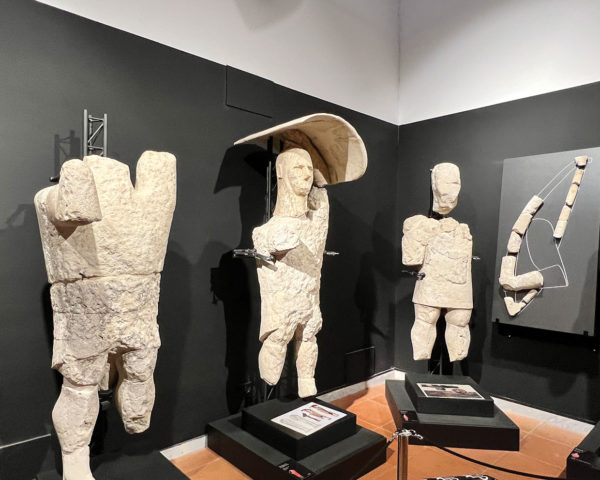
In 1974, a farmer near Cabras uncovered a gigantic limestone head. This led to excavations of a necropolis and the discovery of the Giants of Mont’e Prama.
In 2014, the Civic Museum in Cabras exhibited three seven-foot high reconstructed stone archers, a warrior and five boxers with carved circular eyes and long, plaited or twisted hair over their shoulders. In Cagliari’s Archaeological Museum, a further eighteen giants are displayed. Only one giant has left Sardinia, taken to be displayed in New York.
Archaeologists continue to excavate the area and develop their understanding of these Bronze Age inhabitants of the island.
10. Tharros
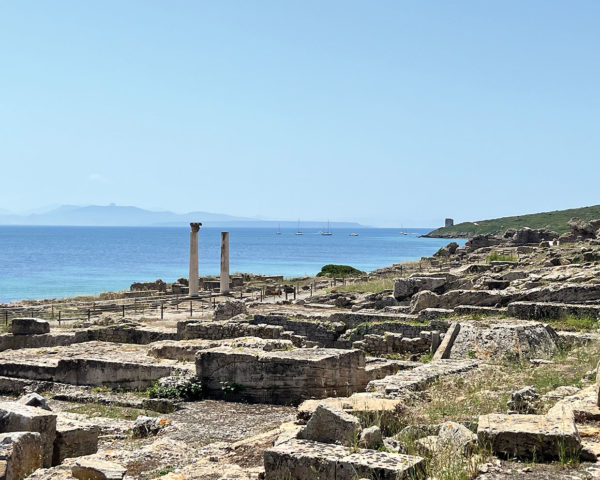
In the 8th century BC, the Phoenicians built Tharros on a strip of land on the Sinis peninsula jutting into the Gulf of Oristano. They found two safe harbours for their ships that protected them from the Mistral and Scirocco winds, which they used to trade food, gold and silver.
The Nuragic remains at Tharros include a tophet, which was a sacred area where children’s ashes were buried in urns. However, most of the remains in Tharros are Roman, following their 600-year rule. There is a network of Roman basalt and brick roads, three thermal baths, a fountain, the forum, aqueducts, sewers and dwellings. Two reconstructed Corinthian columns sit on the coastline, with one original capital that stands out against the sea and sky.
This lesser-known area in western Sardinia has so much still to be discovered and understood, from nuraghi to sacred wells. I marvel at how Sardinians continue to cherish their heritage, hold on to their language, and really want to show visitors the true character of their island. The enthusiasm and passion they share make any journey here an endlessly fascinating and multi-layered experience.
Experience more of the island’s charms with this walking holiday in Sardinia
Written by Penny Wainwright for Italia! #217 (October/November 2025)